Motorepuestos Arias POS
A multi-branch point-of-sale platform engineered as a SaaS product for retail businesses of any size.
Role
Sole Engineer — architecture, product & delivery
Industry
Retail · Auto Parts
Timeline
Client build, evolved into a reusable SaaS
Stack
12 technologies
What this project is
An auto-parts store owner needed software to replace a tangle of manual processes — tracking inventory, checking stock movements, invoicing, and keeping tabs on customers who buy on credit. Rather than building a throwaway one-off, I engineered the system as a SaaS product with a multi-branch, multi-warehouse, multi-register architecture so it can adapt from a single small shop to a larger multi-location business.
Context
Direct engagement with the owner of Motorepuestos Arias, a local auto-parts store, who needed to move day-to-day operations off spreadsheets and paper.
Main goal
Replace manual sales, inventory, and credit tracking with one reliable system — and make that system reusable for other retailers.
The problem — and the value delivered
Written for owners and stakeholders: what was broken, why it mattered, and what changed.
The problem
Sales, inventory, invoicing, and customer credit were handled manually. There was no reliable view of stock on hand, no low-stock warnings, and credit balances lived on paper — which meant lost time, human error, and money that was easy to lose track of.
Why it mattered
For a parts retailer, stock accuracy and fast invoicing are the business. Every mistake is a missed sale, a wrong count, or a receivable that quietly disappears.
The solution
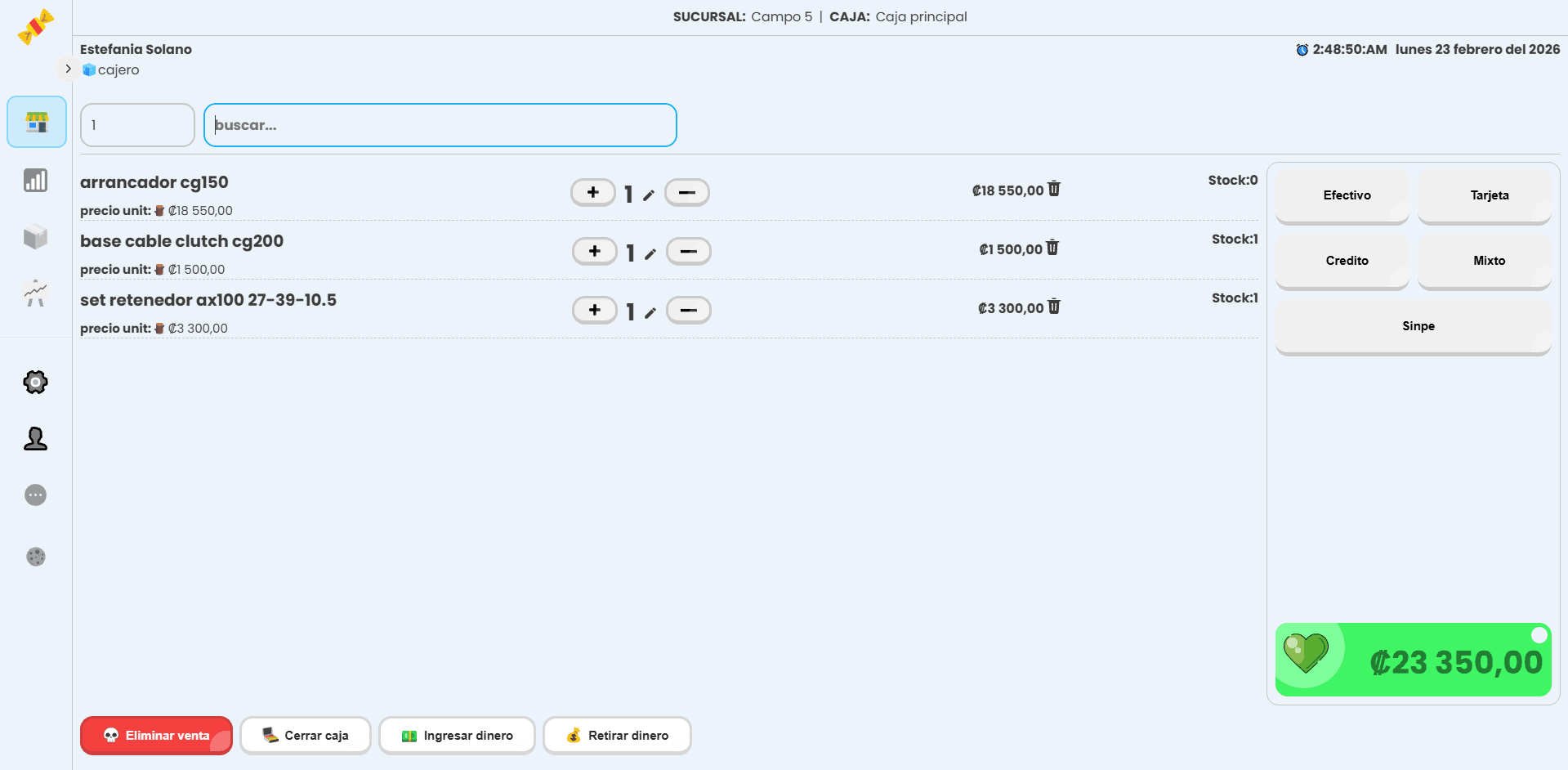
A web point-of-sale system that handles the full retail loop: fast invoicing, product management, real-time inventory with movement history, low-stock alerts, customer and supplier records, credit sales with a running receivables ledger, and role-based access for cashiers and admins. Built to run one store today and many tomorrow.
Benefits delivered
- Real-time inventory with a full history of every stock movement.
- Automatic low-stock alerts so nothing sells out unnoticed.
- Fast, customizable invoicing tailored to the business.
- Credit sales tracked per customer with a clear receivables balance.
- Roles and permissions (cashier, admin) that keep operations safe.
- One codebase that scales from a single shop to multi-branch operations.
Paper → Digital
Operations moved off spreadsheets
Real-time
Inventory & stock movements
Multi-branch
SaaS-ready architecture
Architecture & implementation
Written for developers and recruiters: the technical decisions, tradeoffs, and lessons.
Architecture
The core design challenge was modeling a multi-branch, multi-warehouse, multi-register domain in a single, tenant-adaptable product. I approached it with SOLID principles and Clean Architecture, isolating business rules from the data and UI layers, and going through multiple refactoring passes until the code was polished and well-structured. Supabase provides Postgres, authentication, and object storage behind a typed data layer, with TanStack Query owning server state, caching, and invalidation on the client.
Frontend
- React
- TypeScript
- Vite
- Tailwind CSS
- TanStack Query
Backend & Data
- Supabase
- PostgreSQL
- Supabase Auth
- Supabase Storage (S3)
Testing
- Vitest
- Playwright
Delivery
- Vercel
- Git & GitHub
Implementation highlights
Multi-branch / multi-warehouse / multi-register model
A single data model that cleanly separates branches, warehouses, and registers so stock and sales stay correct across locations — the hardest and most valuable part of the build.
Role-based access control
Cashier and admin roles with scoped permissions, enforced through Supabase Auth and row-level policies.
Inventory movement ledger
Every stock change is recorded, giving an auditable history and driving real-time low-stock alerts.
AI-assisted engineering
I used AI assistants (Claude with Opus models, and Gemini) to pressure-test design decisions — comparing tradeoffs, hunting for weak points, and reviewing refactors — while keeping full ownership of the architecture.
Challenges
Keeping stock correct across many locations
Multi-warehouse inventory means concurrent movements can corrupt counts. I modeled stock as an append-only movement ledger so quantities are always derivable and auditable.
One product, many businesses
Turning a client tool into a SaaS meant designing for configurability without special-casing. Clean Architecture boundaries let the same rules serve a tiny shop or a multi-branch operation.
Lessons learned
- Modeling the domain first — before the UI — pays off across every later feature.
- An append-only ledger beats mutable counters for anything money- or stock-related.
- AI review is a force multiplier when you stay the decision-maker, not a passenger.
What it does
Fast Invoicing
Customizable invoices built for quick checkout.
Inventory Control
Real-time stock with full movement history.
Low-Stock Alerts
Automatic warnings before items run out.
Multi-Warehouse
Stock tracked across branches and warehouses.
Roles & Permissions
Scoped access for cashiers and admins.
Credit & Receivables
Per-customer credit sales and balances.
Full technology stack
Want something like this for your business?
I turn manual, error-prone workflows into reliable software. Let's talk about what you need.
Start a conversation